
Select Page

Detailed introduction of DC Hybrid Propulsion System

Jun 25, 2026 | Substitutes News | 0 comments

    Driven by global maritime emission reduction policies, ship electrification and low-carbon transformation have become irreversible industry trends. As a next-generation marine power solution replacing traditional AC power distribution systems, the DC Hybrid Propulsion System has been widely popularized in commercial ships, engineering vessels and luxury yachts for its high efficiency, low fuel consumption and flexible energy scheduling. This article comprehensively interprets its definition, system composition, operating modes, technical advantages, application cases and future industry trends.

What is a DC Hybrid Propulsion System?
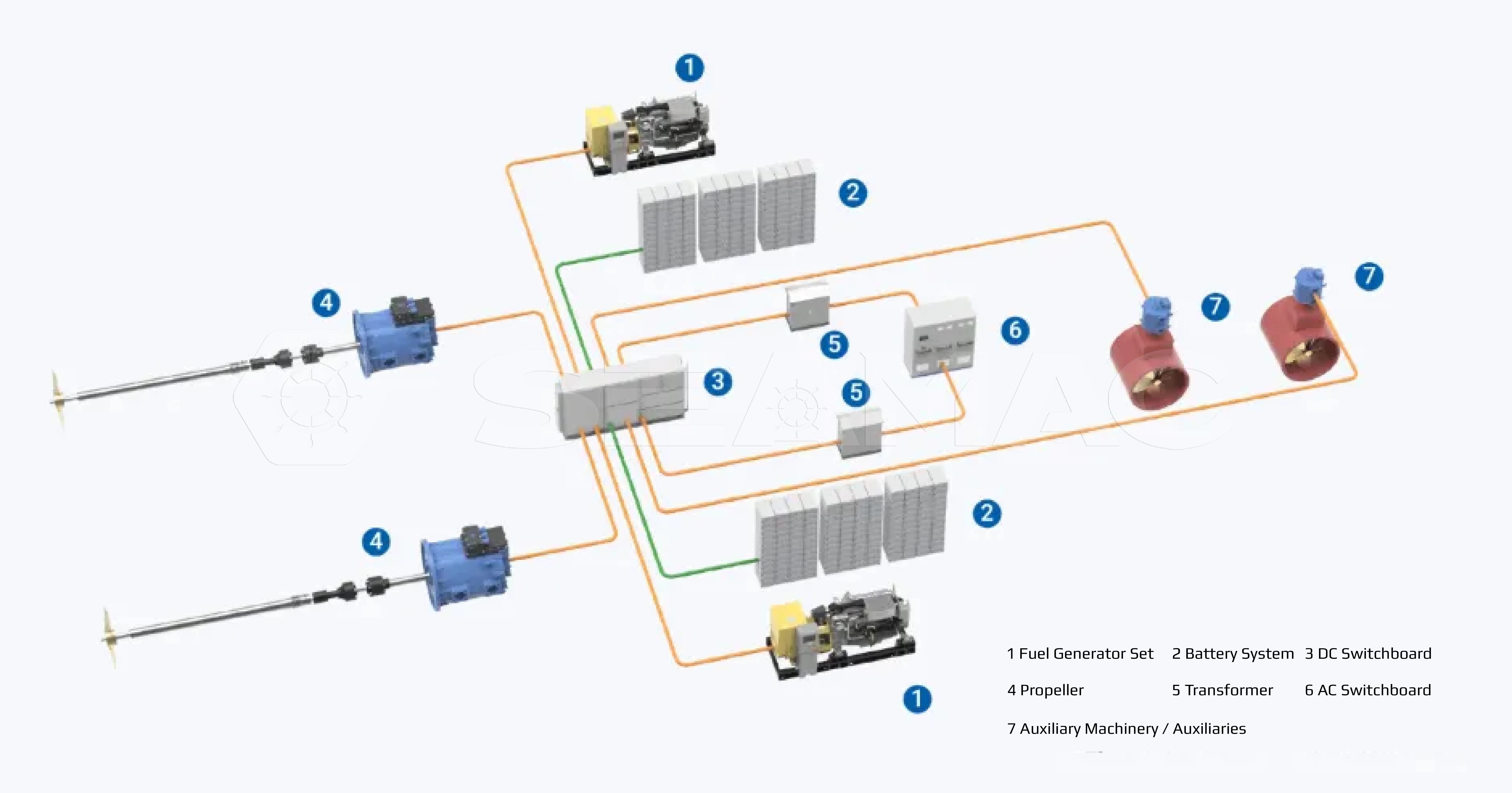
DC Hybrid Propulsion System

A DC Hybrid Propulsion System takes the DC Bus as its core. It integrates various energy sources and equipment including diesel engines, generators, battery energy storage systems, shore power, power electronic converters and propulsion motors into a unified electrical power platform for ship propulsion.

Different from the conventional AC Grid power distribution system, the DC hybrid system removes the strict synchronous operation requirement between generators. It realizes centralized collection, distribution and management of electric power via the DC bus, enabling flexible combination and optimal control of power sources.

Driven by increasingly stringent energy conservation and emission reduction regulations for ships, alongside rapid advances in battery energy storage and power electronics technologies, DC hybrid propulsion systems have been widely deployed on the following vessel types: Harbor Tugs, Ro-Pax Vessels, Ferries, Yachts, Offshore Support Vessels (OSVs), Fishing Vessels, Research Survey Vessels, Inland Waterway Ships.

Components of DC Hybrid Propulsion System

    The complete DC hybrid propulsion system consists of six core modular units, which cooperate with EMS energy management system to realize intelligent power dispatch.

Diesel Generator Set
Diesel engines drive generators to produce electricity, which is the main conventional energy source for ocean-going and long-navigation ships.
Main functions:
  • Provide basic navigation electricity
  • Supply power to the propulsion system
  • Supply ship hotel daily load power
  • Charge on-board energy storage batteries
Core Features:
  • Flexible start-stop according to real-time load demand
  • Long-term operation within optimal fuel consumption range
  • Effectively reduce low-load idle running time
Battery Energy Storage System (BESS)
Battery systems are the core new-energy component of DC hybrid ships, supporting peak regulation and zero-emission navigation.
Three Core Functions:
  1. Peak shaving: Release power rapidly under sudden high-power working conditions (tug push, DP positioning, rapid acceleration), avoid generator instantaneous overload and extra diesel engine startup.
  2. Load Smoothing: Suppress frequent load fluctuation of diesel engines, improve fuel combustion efficiency, reduce mechanical wear and extend equipment maintenance cycle.
  3. Zero-emission operation: Shut down diesel engines in ports and environmentally sensitive waters, realize full battery-powered zero-emission & zero-noise navigation.
Bidirectional Converter
Bridge equipment connecting battery system and DC bus.
Main functions: Realize battery intelligent charging/discharging, system DC voltage stabilization, and precise bidirectional energy flow control.
DC Bus
The core control hub of the entire DC hybrid system.
Core effect: Converge all on-board power sources, distribute electric power to each navigation load, realize cross-equipment energy sharing.
Compatible access equipment: Generator, energy storage battery, shore power, fuel cells, photovoltaic power generation system, with ultra-high post-project scalability.
Drive Converter
Special control unit for propulsion motors.
Function: Realize motor stepless speed adjustment, torque adjustment, forward and reverse rotation control.
Advantages: Millisecond-level fast response, high conversion efficiency, excellent vessel maneuverability.
Electric propulsion motor
Core execution equipment to convert electrical energy into mechanical propulsion power.
Common types: Permanent magnet synchronous motor (PMSM), Induction asynchronous motor (IM), Permanent magnet shaft motor.
Equipment Features: High operating efficiency, high output torque, low operating noise, simple daily maintenance.
Five Standard Operating Modes

    Matched with EMS energy management system, the system switches modes automatically or manually to adapt to all navigation scenarios.

Mode 1: Pure diesel engine power generation mode
Applicable scenario: Long-distance cruise, continuous high-load open sea operation
Energy workflow: Diesel engine → Generator → DC bus → Propulsion motor
Features: Simple system logic, battery standby for emergency use

Mode 2: Diesel engine + battery combined operation mode
Applicable scenario: Variable load conditions, tugboat berthing operation, dynamic DP positioning
Energy workflow: Diesel generator + battery → DC bus → propulsion motor
Features: Battery compensates peak load, generator runs stably; Comprehensive fuel saving rate 10% – 25%

Mode 3: Pure Battery Propulsion Mode
Applicable scenario: Port inbound & outbound, environmental protection restricted waters, night low-noise operation
Energy workflow: Battery → DC Bus → Propulsion Motor
Features: Zero emissions, zero noise, stable low-speed operation

Mode 4: Shore power supply mode
Applicable scenario: Long-term vessel berthing at port
Function realization: Shut down all diesel engines, on-board battery charging, full ship hotel power supply, effectively cut port air pollution

Mode 5: EMS Automatic Optimization Mode
EMS real-time monitors vessel power demand, battery SOC, generator load and real-time fuel consumption, intelligently selects the optimal operating mode automatically.
Core goal: Minimum fuel consumption, minimum pollutant emissions, maximum service life of marine equipment

1. No generator synchronous operation required
AC system: Must keep frequency & phase consistent for grid connection; DC system: Cancel synchronous limit, simpler control, easier parallel grid connection
2. Lower fuel consumption
AC unit often runs under 20%-40% low load; DC unit stably runs in 75%-90% economic working zone, fuel saving rate 15% – 30%
3. Compliant low emission
Cut CO₂, NOx, particulate PM emissions fully, meet IMO Tier III, EEXI, CII global maritime environmental regulations
4. Compact cabinet layout
Cancel large distribution board, synchronous equipment and partial transformers, save 10% – 20% cabin space
5. Ultra-fast dynamic response
Battery millisecond-level response vs diesel engine second-level response, more stable DP positioning, faster thrust response for tugboats
1. Harbour Tugboat
Working characteristic: Long low-load waiting time, short high-power berthing operation time.
Operational benefit: Fuel consumption reduced by 20%-35%, comprehensive exhaust emissions reduced by more than 30%.
2. Offshore support vessels (OSVs)
Working characteristic: Frequent long-time DP dynamic positioning operation.
Operational benefit: Battery peak clipping reduces generator start-stop frequency, improves marine positioning stability greatly.
3. Fixed-route Passenger Ferry
Working characteristic: Fixed inland/coastal route, frequent port entry and exit.
Operational benefit: Adapt to full battery navigation + shore power charging mode, realize zero-carbon green passenger shipping.
As the International Maritime Organization (IMO) continues to upgrade global vessel emission reduction targets, DC hybrid technology has become the core development direction of ship full electrification.
Future upgraded system will integrate diversified new energy modules to build intelligent multi-energy network:
  • High-safety lithium battery energy storage system
  • Hydrogen fuel cell power unit
  • On-board methanol reforming hydrogen production system
  • Ship surface photovoltaic power generation module
  • AI-driven intelligent EMS energy management optimization system

Conclusion

    DC hybrid propulsion systems, through the deep integration of diesel engines, battery energy storage, and advanced power electronics technologies, have enabled the transformation of ship propulsion systems from “mechanical drive” to “intelligent electric drive.” Compared to traditional propulsion solutions, they offer significant advantages in fuel economy, emission control, dynamic response, and system flexibility, and have become an important technological route for the development of green and intelligent ships.
    With the continuous advancement of new energy and energy storage technologies, DC hybrid propulsion systems will play an increasingly important role in port tugboats, passenger ferries, offshore vessels, fishing boats, and future zero-carbon ships, providing strong technical support for the green and low-carbon transformation of the global shipping industry.


WhatsApp Online logo

Online Service


Sales Manager-Mrs.Wendy Fu

Sales Director-Mr.Jasper Lee

Parts Service-PartMac

Technical Service

Contact EMAC Now!

Subscribe To Our Newsletter

Subscribe To Our Newsletter

Subscribe to get the latest updates from www.hangzhou-gearbox.com

You have Successfully Subscribed!

Pin It on Pinterest