
Project Background
Cutter suction dredgers are generally used for dredging regular linear areas such as waterways, basins and berths, where the spud is positioned on the axis of the dredging trench with equal excavation areas for the left and right halves of the trench. However, when operating in curved areas like ship turning circles, adopting the linear zoning method for such curved zones will result in frequent ship relocations and increased corner dredging work for the dredger.
Objectives of the Achievement
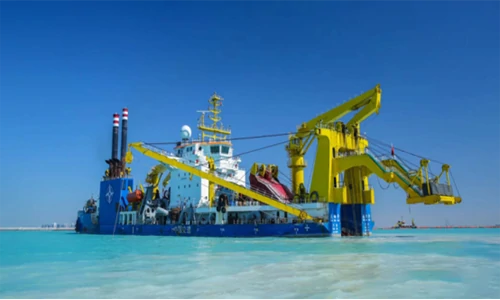
This research focuses on the arc-section dredging construction technology of cutter suction dredgers. By periodically adjusting the spud positioning line and adopting arc-section construction in circular areas such as turning circles, the frequency of ship relocation, trenching and corner trimming is reduced, so as to improve construction continuity and efficiency, as well as the slope quality of the curved outer boundary.
Innovations
Developed the technology for determining and analyzing the spud positioning line and spud location during the arc-section dredging construction of cutter suction dredgers, which reduces the frequency of ship relocation, trenching and corner trimming in the dredging construction of circular areas and effectively improves construction continuity and efficiency.
Developed a calculation method for the optimal strip width of curved dredging trenches and the spacing between tangent points of spud positioning lines, providing technical support for arc-section dredging construction.
Developed two spud shifting and positioning technologies for self-propelled cutter suction dredgers, namely “cutter head grounded, bow thruster + twin-screw with straight rudder and forward-reverse propulsion” and “cutter head grounded, bow thruster + twin-screw with large rudder angle and forward propulsion”, which improves the efficiency of ship relocation.
Developed a zoned dredging technology for circular dredging areas that combines linear striping in the central area with arc striping in the edge area, which not only improves construction efficiency but also ensures the construction quality of the curved outer boundary.


